Radon Mitigation in Elmhurst, IL
High radon result? We connect DuPage homeowners with independent, IEMA-licensed mitigation contractors. Free, no obligation.
Request a free quote
How it works
- 1. Tell us what you needAnswer a few quick questions in our short form. It takes about a minute.
- 2. We match you with one local proWe pass your request to one independent radon mitigation contractor who works in your area.
- 3. They contact youThe pro reaches out to set up a visit and a written quote. You decide; there's no obligation.
- Free for homeowners
- One pro, not a bidding list
- Local DuPage focus
- We only refer to IEMA-licensed radon mitigators
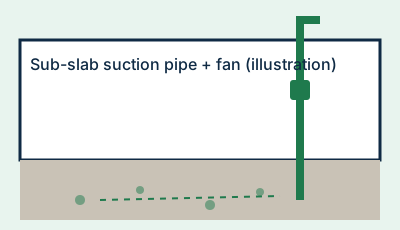
Elmhurst blends 1920s–1950s bungalows and Cape Cods with many newer rebuilds. Newer homes in Illinois may have been built with passive radon-resistant features (a vent pipe stubbed up through the house); if yours has one, a contractor can often add a fan to make it active, which is usually cheaper than a full new system. Look in your basement or utility room for a labeled PVC pipe running into the floor.
What IEMA's radon test records show for Elmhurst
IEMA publishes radon results reported by licensed measurement professionals. For test addresses in Elmhurst, we counted 4,289 valid tests on homes without a mitigation system; 33% were at or above EPA's 4.0 pCi/L action level and 10% were at or above 8.0 pCi/L.
For comparison, 42% of tests were at or above 4.0 pCi/L across the 26 DuPage-area and nearby cities we pulled from the same data, so Elmhurst is below that average. These are mostly real-estate and homeowner-ordered tests, not a random sample, so they can't predict your house — neighbors on the same block can test very differently. The only way to know is to test your own home.
Housing in Elmhurst and what it means for radon
About 45,786 people lived in Elmhurst in the 2020 Census. The median home there was built around 1966, and the biggest share of its housing went up before 1970 (55% before 1970, 15% from 1970–1989, 19% from 1990–2009, 11% since 2010). Roughly 72% of homes are detached single-family houses and 5% are townhouses or other attached single-family homes; about 80% of households own their home.
About 11% of Elmhurst homes were built since 2010. Illinois' Radon Resistant Construction Act has required a passive radon pipe in new homes since June 1, 2013, so a newer house may already have a capped vent pipe. If it tests high, a licensed mitigator can often add a fan to that pipe instead of building a whole new system — usually the cheapest fix.
With 55% of homes built before 1970, many Elmhurst basements have older block walls, floor drains or additions on slab or crawlspace. Those openings can affect where a mitigator puts the suction point and whether a crawlspace needs its own membrane, so ask each contractor how they'll treat every foundation type in the house.
Next steps in Elmhurst
- If you haven't, run a short-term test in the lowest lived-in level (EPA guidance). For a home sale, use a licensed measurement professional.
- If you're at or above 4 pCi/L, get a quote from an IEMA-licensed mitigator — Illinois requires the license for paid mitigation work.
- After installation, retest to confirm the level dropped.
Nearby areas
Lombard Glen Ellyn Addison Villa Park
Also see: cost guide · FAQ
Request a free radon mitigation quote in Elmhurst
Fill this out and an independent local contractor will reach out, usually within one business day (response times depend on the contractor).
Sorry, your request did not go through. Please check your name, a 10-digit phone number and the consent box, then try again.
DuPage Radon Mitigation Referral is a referral service, not a contractor. We only refer radon requests to IEMA-licensed mitigation professionals.