Radon Mitigation in Wheaton, IL
High radon result? We connect DuPage homeowners with independent, IEMA-licensed mitigation contractors. Free, no obligation.
Request a free quote
How it works
- 1. Tell us what you needAnswer a few quick questions in our short form. It takes about a minute.
- 2. We match you with one local proWe pass your request to one independent radon mitigation contractor who works in your area.
- 3. They contact youThe pro reaches out to set up a visit and a written quote. You decide; there's no obligation.
- Free for homeowners
- One pro, not a bidding list
- Local DuPage focus
- We only refer to IEMA-licensed radon mitigators
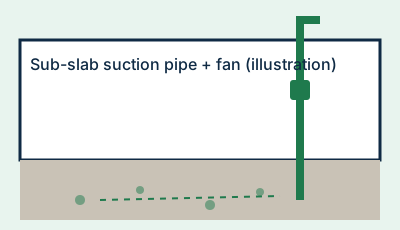
Wheaton's housing ranges from early-1900s homes near downtown to post-war ranches and newer subdivisions. Age doesn't predict radon — EPA is clear that new and old, drafty and tight homes can all test high — so the only way to know is to test. If your Wheaton test is at or above 4 pCi/L, a licensed mitigator will usually inspect the basement, check for a sump pit (often a good suction point) and propose a fan location outside or in the garage attic.
Older Wheaton homes with stone or block foundations may need extra sealing or more than one suction point, which can push cost toward the upper end of the estimate range.
What IEMA's radon test records show for Wheaton
IEMA publishes radon results reported by licensed measurement professionals. For test addresses in Wheaton, we counted 6,869 valid tests on homes without a mitigation system; 47% were at or above EPA's 4.0 pCi/L action level and 19% were at or above 8.0 pCi/L.
For comparison, 42% of tests were at or above 4.0 pCi/L across the 26 DuPage-area and nearby cities we pulled from the same data, so Wheaton is above that average. These are mostly real-estate and homeowner-ordered tests, not a random sample, so they can't predict your house — neighbors on the same block can test very differently. The only way to know is to test your own home.
Housing in Wheaton and what it means for radon
About 53,970 people lived in Wheaton in the 2020 Census. The median home there was built around 1976, and the biggest share of its housing went up between 1970 and 1989 (34% before 1970, 48% from 1970–1989, 13% from 1990–2009, 5% since 2010). Roughly 58% of homes are detached single-family houses and 12% are townhouses or other attached single-family homes; about 72% of households own their home.
Nearly half of Wheaton's homes (48%) date from 1970–1989, which includes a lot of split-levels and raised ranches. Those often combine a basement slab with a crawlspace or slab-on-grade section, and a good system design accounts for both.
Next steps in Wheaton
- If you haven't, run a short-term test in the lowest lived-in level (EPA guidance). For a home sale, use a licensed measurement professional.
- If you're at or above 4 pCi/L, get a quote from an IEMA-licensed mitigator — Illinois requires the license for paid mitigation work.
- After installation, retest to confirm the level dropped.
Nearby areas
Glen Ellyn Lisle Carol Stream Glendale Heights Naperville radon mitigation
Also see: cost guide · FAQ
Request a free radon mitigation quote in Wheaton
Fill this out and an independent local contractor will reach out, usually within one business day (response times depend on the contractor).
Sorry, your request did not go through. Please check your name, a 10-digit phone number and the consent box, then try again.
DuPage Radon Mitigation Referral is a referral service, not a contractor. We only refer radon requests to IEMA-licensed mitigation professionals.